Two new Rothman books extend the life works of the late professor
by Barbara Cloud
In life, historian Hal Rothman was one of UNLV’s most prolific scholars. In death, his legacy in print continues.
Two new books, Blazing Heritage and Playing the Odds, have been published since his February 2007 death from Lou Gehrig’s disease. The new works bring the Rothman-authored library to 13 books plus numerous edited volumes. His contributions to our understanding of history did not stop with books. His ability to put complex issues into succinct, everyday language made him a media darling. He wrote for or was quoted by major print and broadcast news organizations across the country and abroad.
A Google search of his name brings more than 10,000 hits with his perceptive comments about Las Vegas, tourism, and the American West, as well as moving accounts of the last months of his life, when he and his family and friends were coping with the disease that took his life at the early age of 48.

In Blazing Heritage, on which Rothman was working when he died, the historian returned to the national parks, a topic he explored before he came to UNLV in 1992. The book begins in 1886 in the 14-year-old Yellowstone National Park when a 50-man cavalry troop attempted to extinguish fires scattered all over the 2 million-acre park.
“A pattern began at that very instant,” he writes. “The soldiers and the resources available to them were simply not sufficient to extinguish a fire of this size.” He proceeds to chronicle more than a century of fire in the national parks — especially parks in the Western U.S. — noting the evolution of strategies to suppress fires and the ongoing inadequacy of fire-fighting resources, as well as the use of fire as a tool.
Rothman describes how the National Park Service became a leader in fire management practices, especially after the lessons of the 1988 Yellowstone fire. He predicted, however, that drought and failure of communities to clear underbrush — especially in the “wilderburbs,” the suburban sprawl that now encroaches on rural and wild land — will force the Park Service “to redefine the boundaries of its strategy.”
Blazing Heritage closes with a typical Rothman application of history to current events. In a final chapter titled “The Hazard of New Fortunes: Outlet, Cerro Grande, and the Twenty-First Century,” Rothman references California historian and frequent collaborator Mike Davis, who questions whether, as Rothman puts it, “communities that built in hazardous fire regions merited the response of public services,” an issue that arose during the 2007 fires in Southern California. Had he been available when the fires ravaged, publication of the book would surely have had reporters calling for comments.
Environmental historian Lincoln Bramwell, who coined the “wilderburbs” term, edited Playing the Odds, a collection of 66 columns Rothman wrote for the Las Vegas Sun and other publications. It explores Las Vegas’s place as the “First City of the Twenty-First Century” and then looks beyond to the Western environment and issues facing the region and the nation. High-rise developments, eminent domain, water wars, the division between the haves and have-nots — they’re all in the collection, giving readers a last chance to benefit from the articulate and accessible insights of the professor who embraced his adopted hometown, warts and all.
Bramwell is now at UNLV drafting the manuscript for yet another Rothman book, this one on Yosemite National Park. It was a partnership between Rothman, history professor Andrew Kirk, who directs UNLV’s public history program, and the Park Service. Graduate students taught by Rothman and Kirk completed much of the research for the book, which is slated for publication in 2009.
Bramwell, a recent Ph.D. graduate from the University of New Mexico, says he first met Rothman at a history conference and was impressed by the interest the professor took in a student’s work. “I went up to him to ask some questions,” Bramwell remembers, “and the next thing I knew he was sending me drafts of chapters of his project at that time and hiring me to do field research for him. I had a wonderful experience working with him. He was one of the most generous scholars I’ve met.”
Rather than feeling uneasy about following in Rothman’s footsteps, Bramwell sees completing the Yosemite project as an opportunity to reinforce the late historian’s legacy, much as editing Playing the Odds was his “tribute” to the senior scholar.
More: The history department website (history.unlv.edu) includes a Rothman memorial page with information on the Hal Rothman Fund for UNLV Students.

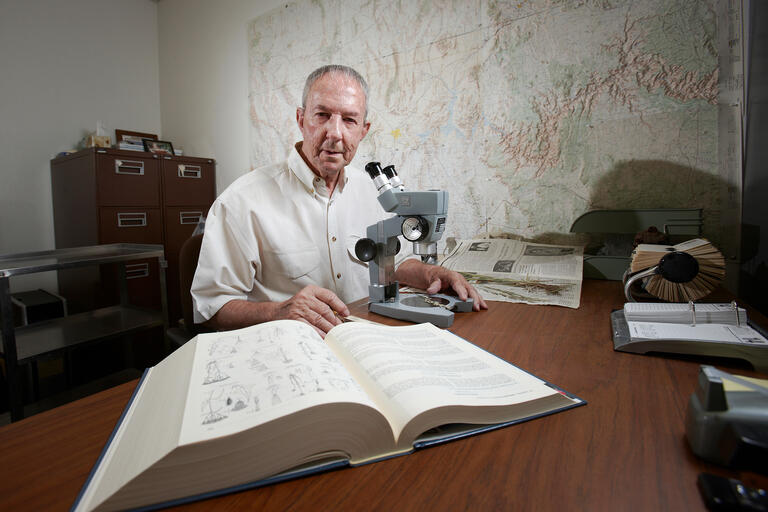
History professor Hal Rothman, who died last year from Lou Gehrig’s disease, was a high-profile commentator on all things Las Vegas, from the Strip to the recreational activities he loved.
Blazing Heritage: Wildland Fire in the National Park System
by HAL ROTHMAN, history professor
Oxford University Press, 2007
Playing the Odds: Las Vegas and the Modern West
by HAL ROTHMAN
(edited by LINCOLN BRAMWELL)
University of New Mexico Press, 2007
Short Stories
Minimal Damage: Stories of Veterans
by H. LEE BARNES, ’89 BA English
University of Nevada Press, 2007
In his most recent work, the former Green Beret leaves the Las Vegas of his The Lucky and Dummy Up and Deal to return to war zones. Minimal Damage contains seven short stories and a novella to tell of returned veterans attempting to live with the trauma they experienced in Vietnam, Korea, Somalia, Iraq, and elsewhere. Barnes, who teaches English and creative writing at the College of Southern Nevada, has received several awards for his short fiction.
Summer Dreams, Winter Wishes
by ANN MCDONOUGH, director of gerontology and senior adult theatre, and DOUGLAS HILL, theatre professor
Armita, 2006
Summer Dreams is the second anthology of theater materials for senior adult productions edited by Hill and McDonough, who is now interim dean of University College. Their focus is on scripts that reflect “modern maturity in the new millennium,” with its many possibilities for older adults, rather than those that are based on dying or the “disease of the week.” They contacted playwrights, some of whom had written specifically for UNLV senior adult theatre, or had done scripts that supported the mission. Included are works of the UNLV graduate playwriting program alumni. The senior adult theatre program has produced most of the plays in the anthology.