UNLV Magazine UNLV

UNLV Magazine Home
Back Issues
Request a Back Issue
Subscribe to Magazine
Submit Class Notes Entry
Letters Policy
Contact the Editor

Summer 2006

Leaving Gut Reactions Behind

Paula Desutter, career diplomat

When Paula Adamo DeSutter, ’79 BA Political Science and ’83 MA Economics, once told a relative about her nascent career in arms control, she was met with some dismay: “She asked me, ‘Well honey, don’t you like guns?’ I had to tell her that it’s just the really big ones that I was concerned about.” Like nuclear bombs and biological weapons.

Today DeSutter is assistant secretary of state, leading a division of the U.S. State Department charged with evaluating other countries’ compliance with arms-control agreements. In March, her job took her to Tripoli, where her team is working with the Libyan government on plans to eliminate its weapons of mass destruction programs. Sweeping sanctions, rather than lengthy negotiations, led to Libya realizing that greater security could be found in abandoning its WMD programs, DeSutter said. “It was a tremendous thing for a country — without regime change — to come to such a decision,” DeSutter says. “It’s a good feeling when you’re able to conclude with a reasonable degree of confidence that a country has eliminated its weapons programs.”

Debates over administration policy toward negotiations will be at the forefront in the coming months, she says, as the international community evaluates Iran’s nuclear capabilities. She hopes other countries, including North Korea, will follow Libya’s example. “The problems of today are too urgent to have 20 years of negotiation with countries that have no intention to comply, ones that are already violating their current agreements,” she says.

One Thing Leads to Another

Though a UNLV student government leader in the mid-1970s, DeSutter didn’t plot out a career path that would have her grappling with nuclear disarmament. Back before her career in diplomacy, she aspired to be a cocktail waitress because she heard they made a lot of money. Economics professor Thomas White inspired her to turn attention to national issues, beginning with a paper on the effects of the 1979 gas shortage on the Las Vegas economy. The waitress wanna-be eventually earned two UNLV degrees before going on to earn a master of arts degree in international relations from the University of Southern California. It was the early 1980s, the heyday of arms control. A graduate internship at the U.S. Arms Control and Disarmament Agency led to a series of senior staff positions and then to the U.S. Senate Select Committee on Intelligence. She later earned a master’s degree in national security strategy from the National War College.

“I’ve been fortunate in that the things I did naturally led to the next thing,” DeSutter told a UNLV political science class in November. “I didn’t plan it. You develop your skills and keep your eyes open and things tend to work out, but it all started here.”

One such skill is an ability to evaluate issues from different perspectives, to leave behind her American gut reaction. In researching Iran’s approach to a justifiable war, for example, she found that soldiers readily accepted their orders to walk through minefields to clear the path for other troops, thus assuring their place in the afterlife. “It’s a different way of thinking, but that doesn’t make it irrational or crazy. People in countries have cost-benefit calculations different from ours. We have to acknowledge that.”

She was appointed to her current position in 2002 and has found that personnel issues consume a large portion of her time. “It’s important to not only get the right people, but keep them happy — make sure they are empowered within a bureaucratic structure that, like all bureaucracies, suppresses energy and initiative.”

Beltway Balance

Despite her career success, she said her most significant accomplishments in life are her children: 16-year-old Rachel and 13- year-old Paul Joseph. She and her husband, R. Joseph DeSutter, a director at the National Defense University, are raising their children in the Washington, D.C. suburb of Reston, Va. Balancing a demanding career with a family hasn’t been easy, DeSutter said, but she was lucky: When her daughter was born, DeSutter’s mother moved to the Washington area to care for her and later her son while she worked.

“They always had someone who loved them taking care of them, and my mother not only shares my values but she is the source of my values,” she said.

DeSutter’s visit to Las Vegas was her first in about seven years — she made the trip to attend her 30th reunion with fellow graduates of Western High School.

During her stay she couldn’t resist a few pulls on a slot machine. After getting over the surprise that some machines no longer accept coins, she found a numbing comfort in the lights and sounds. “It was very relaxing,” she said. “You don’t have to think. You don’t think about North Korea, you don’t think about Iran.”

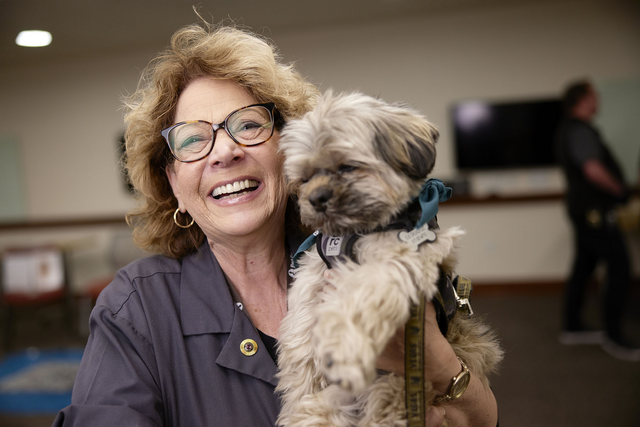
Paula DeSutter